How Closed-Loop BCI Systems Turn Brain Signals Into Real-Time Responses
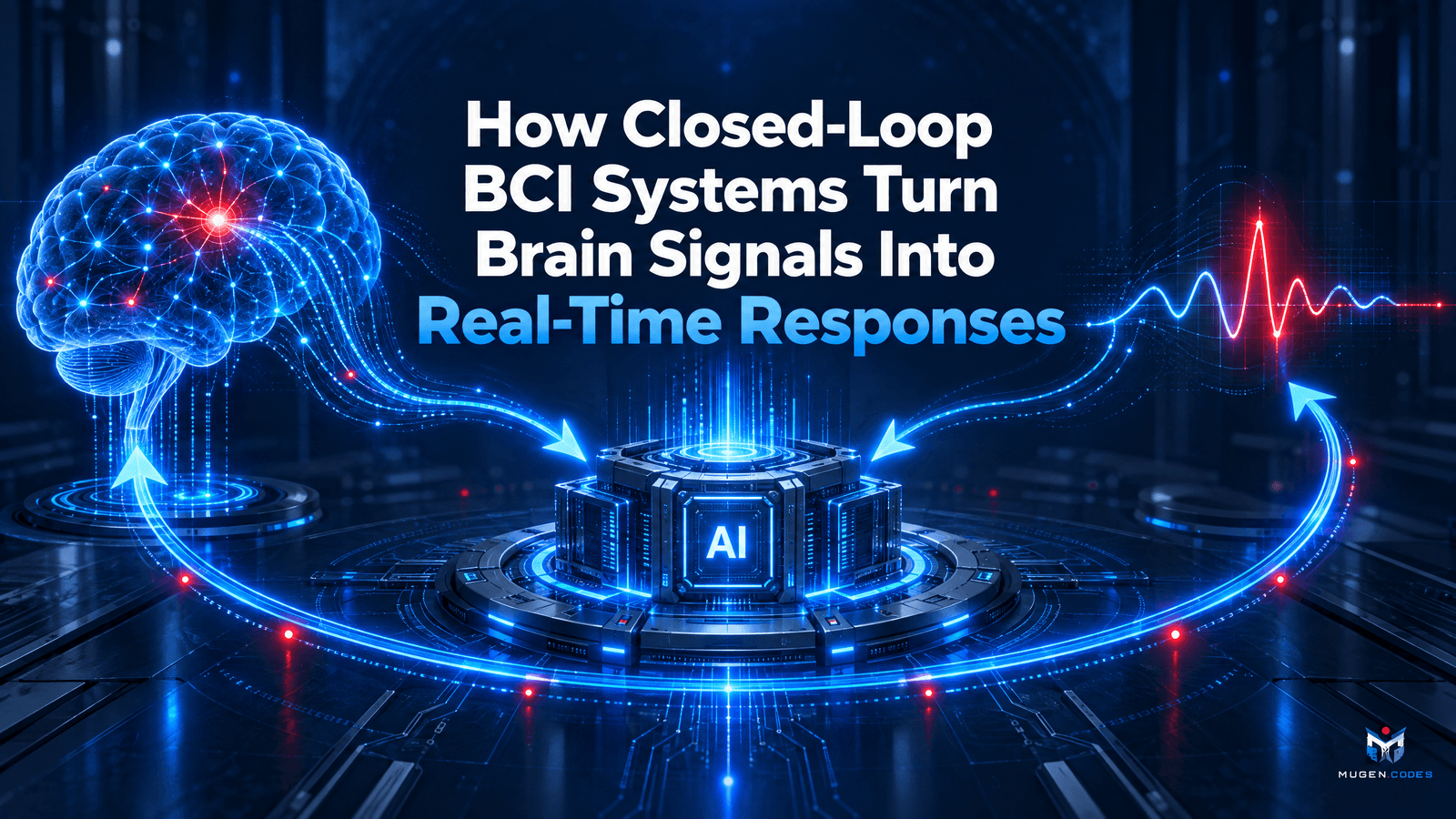
Discover how closed-loop BCI systems turn brain signals into real-time responses through neural decoding, AI, feedback, and software engineering.
TL;DR
- Closed-loop brain-computer interfaces (BCIs) interpret brain activity and use feedback to support continuous interaction between users and connected systems.
- Neural signals pass through acquisition, processing, decoding, and control stages before triggering a response.
- Real-time processing is essential for delivering accurate, timely, and reliable system responses.
- AI and machine learning can help BCIs recognise neural patterns and adapt to changing signals.
- Reliable BCI development requires robust software architecture, hardware integration, and thorough testing.
Brain-computer interfaces (BCIs) create a communication pathway between brain activity and external devices.
They can help users control computer applications, assistive technologies, and robotic systems without relying on conventional physical input. Turning neural activity into useful commands, however, requires more than capturing brain signals.
Closed-loop BCI systems take this process further by using feedback to maintain continuous interaction between the user and the technology.
The system interprets neural signals, produces a response, and returns information that can influence subsequent activity. This cycle makes responsiveness, signal interpretation, and real-time processing central to the system’s design.
Building these systems requires careful coordination between software, neural signal processing, control mechanisms, and connected hardware. Platforms like Mugen.Codes are relevant to this work because they focus on complex software engineering, where system integration, reliable architecture, and performance testing are essential.
Understanding how these elements work together helps explain how closed-loop BCI systems turn brain signals into real-time responses.
Table of Contents
- TL;DR
- What Is a Closed-Loop BCI System?
- The Building Blocks of a Closed-Loop BCI
- How Closed-Loop BCI Systems Turn Brain Signals Into Real-Time Responses
- The Software Architecture Behind Closed-Loop BCI Systems
- Engineering for Real-Time BCI Performance
- How AI and Machine Learning Improve Closed-Loop BCIs
- Challenges in Developing Closed-Loop BCI Systems
- Testing and Validating Closed-Loop BCI Software
- Applications of Closed-Loop BCI Systems
- How Mugen.Codes Supports Advanced BCI Software Development
- FAQs
- Final Thoughts on How Closed-Loop BCI Systems Turn Brain Signals Into Real-Time Responses
What Is a Closed-Loop BCI System?
A closed-loop brain-computer interface is a system that interprets brain activity, uses it to trigger an action, and provides feedback that can influence subsequent interactions.
Rather than operating as a one-way communication channel, it maintains a continuous cycle between the user and the system.
For example, a user controlling a robotic limb through a BCI may generate neural activity associated with an intended movement. The system decodes that activity, sends a command to the limb, and provides visual or sensory feedback about the result. The next interaction can then be influenced by that feedback.
Closed-Loop vs. Open-Loop BCI Systems
The main difference is how each system handles feedback.
- Open-loop BCI: Interprets brain signals and produces an output without using the resulting feedback to adjust the ongoing control process.
- Closed-loop BCI: Uses feedback from the system or environment to support continued interaction and, where designed to do so, adapt subsequent responses.
Closed-loop systems are useful when performance depends on ongoing interaction, such as motor rehabilitation, neuroprosthetic control, and certain forms of assistive technology. Their effectiveness depends on how accurately the system interprets signals and how reliably it responds.
The Building Blocks of a Closed-Loop BCI
A closed-loop BCI combines several components to turn neural activity into an actionable response.
Each component has a distinct responsibility, and the overall system depends on their coordination.
Neural Signal Acquisition
Sensors capture electrical activity or other measurable signals associated with brain activity. Electroencephalography (EEG) is a common non-invasive method, while other applications may use implanted electrodes or different neural recording technologies. The quality of the captured data influences what the system can interpret.
Signal Processing
Raw neural data often contains noise, artifacts, and irrelevant variations. Signal processing techniques help filter unwanted components, prepare the data, and extract useful features for interpretation.
Neural Decoding
Decoding algorithms analyse processed signals to identify patterns associated with a user’s intended action or state. Depending on the application, these algorithms may use statistical methods, machine learning, or a combination of approaches.
Control Mechanisms
The control layer converts decoded information into commands that a connected device or software application can execute. It may also apply decision thresholds and safety constraints to reduce the risk of unintended actions.
Feedback Mechanisms
Feedback communicates the system’s response through visual, auditory, or sensory cues. Depending on the design, this information can help users adjust their behaviour and allow the system to refine its operation over successive interactions.
Together, these building blocks provide the foundation for the real-time signal-to-response process explored in the next section.
How Closed-Loop BCI Systems Turn Brain Signals Into Real-Time Responses
Closed-loop BCI systems transform brain activity into actions through a continuous sequence of signal acquisition, processing, decoding, control, and feedback.
Each stage must work with the others to produce responses that are accurate and timely. The exact implementation depends on the BCI technology and its intended application.
Capturing Brain Activity
The process begins when sensors record brain activity. Electroencephalography (EEG) is commonly used to measure electrical activity through electrodes placed on the scalp, while other systems use implanted electrodes to capture neural signals more directly.
The acquisition software collects these signals as digital data for further processing. Sampling rates, sensor quality, and signal stability all affect how much useful information the system can extract.
Processing the Incoming Signals
Raw neural signals often contain noise caused by muscle movement, eye blinks, electrical interference, and other sources. Before the system can interpret them, signal processing techniques help reduce these unwanted components and prepare the data for analysis.
Depending on the application, this stage may involve:
- Filtering noise and unwanted frequencies.
- Detecting and handling signal artifacts.
- Extracting features associated with relevant neural activity.
- Organising incoming data for continuous processing.
Efficient processing helps the system interpret neural activity without introducing unnecessary delays.
Decoding User Intent
Once the signals are prepared, decoding algorithms analyse them to identify patterns associated with a user’s intended action. For example, a system may distinguish between neural patterns associated with moving a cursor left or right.
Statistical models and machine learning techniques can help classify these patterns. The decoder then converts its interpretation into a command that the control system can use. Since neural activity varies between individuals and over time, decoding accuracy remains an important engineering consideration.
Generating a Real-Time Response
The control system receives the decoded command and translates it into an action. Depending on the application, this could mean moving a cursor, operating a robotic limb, or activating a function in an assistive device.
The software must execute commands within an appropriate response time while managing uncertainty and preventing unintended actions. In applications where incorrect movement could cause harm, control logic may include confidence thresholds, movement limits, or other safety checks.
Returning Feedback to the User
After the system responds, it provides feedback that helps the user understand the outcome. This may be visual feedback on a screen, an auditory cue, or sensory feedback associated with a controlled device.
For example, a user operating a cursor can see whether it reaches the intended target. That information helps the user adjust subsequent attempts and gives the closed-loop interaction its continuous nature.
Adapting Through the Feedback Loop
Feedback can influence both the user’s next action and the system’s subsequent operation. A user may adjust their mental strategy after observing a response, while an adaptive BCI may update its decoding parameters to account for changes in neural signals.
Not every closed-loop BCI automatically retrains its models or changes its control strategy. Adaptation depends on the system’s design and the feedback signals it uses. When implemented appropriately, it can help maintain performance as users, signals, and operating conditions change.
The result is an ongoing cycle in which brain activity informs a system response, and feedback helps guide the next interaction. Making this cycle work reliably requires software architecture that coordinates data processing, decoding, control, and feedback with minimal delay.
The Software Architecture Behind Closed-Loop BCI Systems
Closed-loop BCI software must coordinate neural data acquisition, signal interpretation, device control, and feedback within a unified system.
A modular architecture helps engineers develop, test, and maintain these components without making the entire system dependent on a single processing pipeline.
Core Software Layers
- Data acquisition layer: Receives neural signals from sensors and recording hardware.
- Signal processing layer: Filters incoming data and prepares it for analysis.
- Decoding layer: Interprets neural patterns and estimates the user’s intended action.
- Control layer: Converts decoded intent into commands and applies relevant safety constraints.
- Feedback layer: Communicates system responses to the user and supplies feedback for subsequent interactions.
These layers need reliable communication and well-defined interfaces. Modular design also makes it easier to update a decoder or replace a hardware component without redesigning the entire application.
Engineering for Real-Time BCI Performance
A closed-loop BCI must process incoming signals and deliver responses quickly enough for its intended use.
Delays can disrupt user interaction, while rushed or unreliable processing can compromise accuracy.
Several engineering considerations influence real-time performance:
- Latency: Minimising delays between signal acquisition, decoding, and execution.
- Synchronisation: Keeping data streams and system components aligned in time.
- Computational efficiency: Processing continuous neural data without overloading available resources.
- Predictable execution: Managing processing workloads to meet timing requirements consistently.
- Reliable communication: Preventing data loss or delays between software and connected hardware.
The required response time depends on the application. Cursor control, rehabilitation, and robotic assistance may have different timing and safety requirements. Engineers must therefore measure end-to-end performance against the needs of the intended system rather than optimise speed in isolation.
How AI and Machine Learning Improve Closed-Loop BCIs
Brain signals vary between users and can change with fatigue, electrode placement, and other conditions.
AI and machine learning can help BCI systems recognise complex neural patterns and interpret signals that are difficult to handle with fixed rules alone.
Neural Pattern Recognition
Machine learning models can classify neural activity associated with different intended actions. Their performance depends on the quality of the training data, the selected features, and how well the model generalises to new signals.
Personalised Decoding
Models can be calibrated to individual users because neural patterns are not identical across people. Personalisation can improve interpretation when a general model does not adequately represent a user’s signals.
Adaptive Learning
Some systems update model parameters as new data becomes available. This can help them respond to changing signal characteristics, although adaptation must be carefully controlled to avoid unstable or incorrect predictions.
AI does not remove the need for reliable software engineering. Models still require validation, monitoring, and safeguards, particularly when their outputs control physical devices.
Challenges in Developing Closed-Loop BCI Systems
Developing a reliable BCI involves more than connecting a neural decoder to an output device.
Engineers must account for variable biological signals, real-time constraints, and the consequences of incorrect commands.
Key challenges include:
- Signal variability: Neural patterns can differ across users and change over time.
- Noise and artifacts: Unwanted signals can reduce decoding accuracy.
- Hardware-software integration: Sensors, processing systems, and output devices must exchange data reliably.
- Timing constraints: Delays across multiple processing stages can affect responsiveness.
- System reliability: Software must handle invalid inputs, communication failures, and unexpected conditions.
- Safety: Applications controlling physical devices may need movement limits, confidence checks, and safe fallback behaviour.
- Data privacy: Neural data must be handled securely, with appropriate access controls and protection.
Addressing these challenges requires coordinated design decisions across signal processing, software architecture, control logic, and system integration.
Testing and Validating Closed-Loop BCI Software
Testing helps establish whether a BCI can interpret signals, respond within its timing requirements, and behave safely under expected and unexpected conditions.
Validation should cover individual components as well as the complete system.
Signal Processing and Decoder Testing
- Test preprocessing pipelines with recorded and synthetic neural data.
- Evaluate decoding accuracy across different signal conditions.
- Check how the system handles noisy, incomplete, or unfamiliar inputs.
Real-Time Performance Testing
- Measure end-to-end latency from signal acquisition to system response.
- Test processing under sustained workloads.
- Identify bottlenecks and inconsistent response times.
Hardware-in-the-Loop Testing
Hardware-in-the-loop testing connects software to physical or simulated hardware. It allows engineers to evaluate data exchange, command execution, and failure handling under controlled conditions before relying on the system in practical use.
Safety and Reliability Testing
- Simulate communication failures and unexpected inputs.
- Verify that safety constraints are enforced.
- Test recovery behaviour and system stability.
- Confirm that the system enters a safe state when required.
A structured testing process helps identify weaknesses before deployment and provides evidence that the software meets its technical and operational requirements. For complex BCI applications, this is an essential part of building systems that are dependable, maintainable, and fit for their intended purpose.
Applications of Closed-Loop BCI Systems
Closed-loop BCI systems are useful in applications where ongoing feedback helps users interact with devices or where system responses can be adjusted based on subsequent signals.
Their potential spans healthcare, assistive technology, robotics, and research.
Neuroprosthetics and Robotic Limbs
Closed-loop BCIs can support prosthetic control by translating neural activity into movement commands and using visual or sensory feedback to help users adjust their actions.
Rehabilitation
In neurorehabilitation, BCI systems can connect a user’s brain activity with external feedback or assisted movement. Researchers are exploring how this approach can support motor recovery after neurological injury.
Assistive Communication
BCIs can help people with severe motor impairments interact with computers or communication tools. Feedback allows users to see whether their selections have been recognised and adjust subsequent inputs.
Human-Computer Interaction
Closed-loop systems can support hands-free interaction with digital environments, including cursor control and other computer-based tasks.
Robotics and Research
Researchers use closed-loop BCIs to investigate how people interact with robotic systems and how feedback influences neural activity, motor learning, and control performance.
The suitability of each application depends on signal quality, decoding accuracy, response time, safety requirements, and the needs of the intended user.
How Mugen.Codes Supports Advanced BCI Software Development
Developing closed-loop BCI systems requires software that can process data, coordinate connected components, and respond reliably under real-time constraints.
Mugen.Codes focuses on complex software engineering, making architecture, integration, and validation important considerations when developing advanced technology systems.
Relevant engineering capabilities include:
- Real-time software development: Designing systems that process incoming data and respond within defined timing requirements.
- Embedded systems engineering: Developing software that interacts with hardware and operates within computational constraints.
- System integration: Connecting data pipelines, control software, external devices, and communication interfaces.
- AI and machine learning integration: Incorporating models into software workflows that require consistent and testable outputs.
- Testing and validation: Evaluating system behaviour, performance, and reliability under expected and unexpected conditions.
These engineering principles are relevant to BCI projects where multiple components must work together as a dependable system. The specific approach depends on the project’s technical requirements, hardware, and intended application.
FAQs
What is a closed-loop BCI system?
A closed-loop brain-computer interface interprets brain activity, produces a response, and provides feedback that influences subsequent interaction. This creates a continuous cycle between the user and the connected system.
How does a BCI turn brain signals into commands?
A BCI captures neural signals, processes them to extract useful information, and uses decoding algorithms to identify patterns associated with user intent. The resulting command is then sent to a connected device or application.
What is the difference between open-loop and closed-loop BCI systems?
An open-loop BCI produces outputs without using resulting feedback to adjust its ongoing control process. A closed-loop BCI incorporates feedback into continued interaction, allowing the user or system to adjust subsequent responses.
Why is real-time processing important for closed-loop BCIs?
Real-time processing helps a BCI respond within the time requirements of its application. Excessive delays can disrupt interaction, while unreliable processing may reduce accuracy or compromise safe operation.
How does AI improve closed-loop BCI systems?
AI and machine learning can help identify complex neural patterns, classify intended actions, and adapt decoding models to changing signals. Their effectiveness depends on training data, validation, and how well the models perform under real operating conditions.
Final Thoughts on How Closed-Loop BCI Systems Turn Brain Signals Into Real-Time Responses
Closed-loop BCI systems connect brain activity with real-time actions through a continuous process of signal interpretation, control, and feedback. Making this process work reliably requires more than effective neural decoding. Software architecture, processing speed, hardware integration, and thorough testing all influence system performance.
As BCI technology advances, robust software engineering will remain important for turning research concepts into dependable applications. Developers must account for both the complexity of neural data and the operational requirements of the systems that use it.
Ready to develop software for advanced technologies?
Explore Mugen.Codes to learn how disciplined software engineering, system integration, and testing can support complex technology development.